
Ship hull panel production combines large workpieces, long seams and many repeated stiffener joints. These features make the process a strong candidate for automation—but only when the robot can be programmed quickly and the system can accommodate real-world variation in plate and fit-up. The DONSIN RA series industrial welding robot is designed for this type of heavy fabrication workflow.
Why Hull Panel Welding Is Challenging
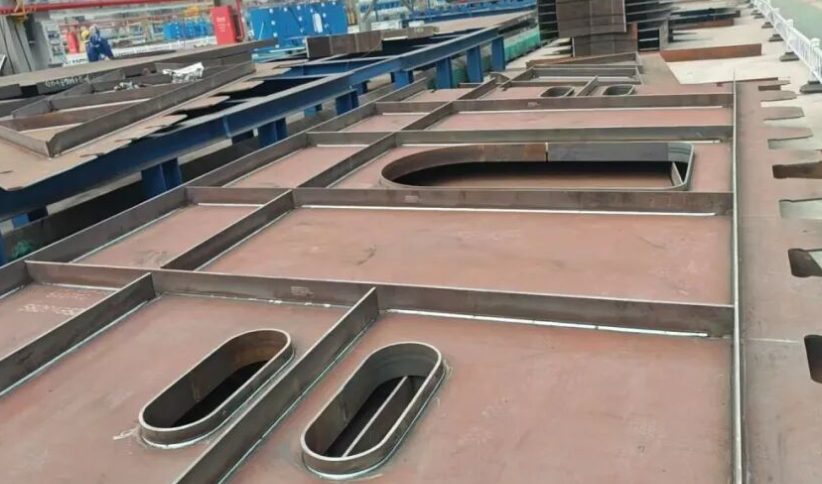
A hull panel may contain a flat or curved plate, longitudinal stiffeners, transverse members, cut-outs and intersections. Although many welds look repetitive, the complete assembly is not a simple small-part robot cell. The work envelope is large, joints can extend for several meters, and heat input can distort the panel as welding progresses.
Traditional fixed-path automation works best when every joint arrives in exactly the same position. Shipbuilding rarely offers that level of uniformity. Plate flatness, tack-up, root gap and member position can vary. An effective system therefore needs both a suitable motion platform and a practical way to teach or adjust the weld path.
Where RA Series Robots Fit in the Production Process
| Hull fabrication task | Potential RA-series role | Key consideration |
|---|---|---|
| Longitudinal stiffener welding | Follow repeated fillet joints along the panel | Track length, joint location and distortion sequence |
| Transverse frame welding | Weld straight and segmented structural seams | Access around intersections and cut-outs |
| Sub-assembly fabrication | Automate brackets, frames and repeated modules | Fixture repeatability and changeover time |
| Block component welding | Handle accessible seams on large structures | Robot reach, external axis and workpiece orientation |
| Repair and rework zones | Re-teach selected paths for controlled rewelding | Inspection result and approved repair procedure |
Teachless Programming for High-Mix Shipbuilding Work
Shipyards do not always produce thousands of identical panels. A conventional robot may be technically capable of making the weld but uneconomical if every new assembly requires lengthy offline programming and specialist intervention. The RA concept addresses this bottleneck by making path creation and adjustment more accessible at the workstation.
The operator identifies the weld path and defines the required motion and process sequence. For repeated structures, programs can be saved and adapted. This approach can reduce the setup burden for batches that are too variable for a dedicated mass-production line but still contain enough repeated welding to justify automation.
System Architecture for Large Hull Panels
The robot arm is only one part of the solution. A ship panel application may require an extended travel axis, gantry or repositioning strategy so that the robot can cover the full structure. The final architecture should be selected from the panel dimensions and joint map—not from arm reach alone.
- RA welding robot: controls torch position and programmed weld motion.
- Travel axis or gantry: extends coverage across long panels where required.
- Welding power source and wire feeder: deliver the specified process and stable consumable feed.
- Seam location or tracking: compensates for joint-position variation when the application requires it.
- Fixture and panel support: control assembly position while allowing the planned welding sequence.
- Safety and fume controls: manage robot motion, arc radiation, spatter and welding fumes.
Planning the Welding Sequence
More arc-on time does not automatically mean a better hull panel. Welding sequence is central to distortion management. Opposing or balanced welds, controlled skip sequences and appropriate clamping may be required to keep the panel within tolerance. The robot program must follow the approved fabrication plan rather than simply welding every visible joint in the shortest travel path.
- Map every weld by joint type, position, length and acceptance level.
- Separate robot-accessible seams from joints that require another process.
- Confirm torch access and robot posture at intersections and openings.
- Develop a sequence that manages heat input and panel distortion.
- Teach representative paths and validate tracking or correction methods.
- Weld a production-representative sample and complete the required inspection.
Benefits to Evaluate in a Real Trial
A project should be judged against measured production data, not a generic automation claim. Useful metrics include arc-on time, setup and teaching time, first-pass acceptance, rework hours, consumable use and operator exposure to repetitive welding. The strongest automation candidates are normally the joints that repeat often, consume significant labor and can be presented to the robot consistently.
Starting with one panel family or sub-assembly gives the engineering team a controlled way to establish fixtures, programs, procedures and inspection results before expanding to more complex structures.
Information Needed for a Shipyard Automation Study
- Panel drawings or 3D models with overall dimensions
- Stiffener and frame geometry
- Material grade, thickness range and joint list
- Annual volume and current welding hours
- Required welding process, procedure and inspection standard
- Factory layout, available floor space and material-flow constraints
Explore the DONSIN RA series teachless industrial welding systems, including the RA-S8Pro welding robot. For a broader selection framework, read our guide to welding robots in shipbuilding.
Plan Your Hull Welding Automation
Send DONSIN a panel drawing and joint list. Our engineers can review robot coverage, travel-axis requirements and the proposed welding sequence.
Request a Shipbuilding Welding Solution


