
DONSIN RW Series Collaborative Welding Robots for High-Mix Fabrication
Nov. 20, 2026
For a fabrication shop that welds pipe assemblies in the morning and enclosure frames in the afternoon, setup time can matter as much as welding speed. Each change in part geometry can mean new fixtures, different torch angles, and another robot program to prepare and test. When batches are small, that work can make a fixed welding cell difficult to justify.
The DONSIN RW Series collaborative welding robot is designed for shops that change jobs frequently. It combines a compact robotic arm, an arc welding power source, a wire feeder, and a torch in one system. Operators can teach weld paths by guiding the arm at the torch, and the mobile base lets the shop reposition the system as production needs change.
How hand-guided teaching works
The operator first secures the part in a fixture, then guides the torch to the joint and uses the torch-mounted keypad to record points along the weld path. The operator sets the welding parameters and checks torch clearance before running the job. Once the setup has been validated, the robot can repeat the taught path on subsequent parts held in the same position.
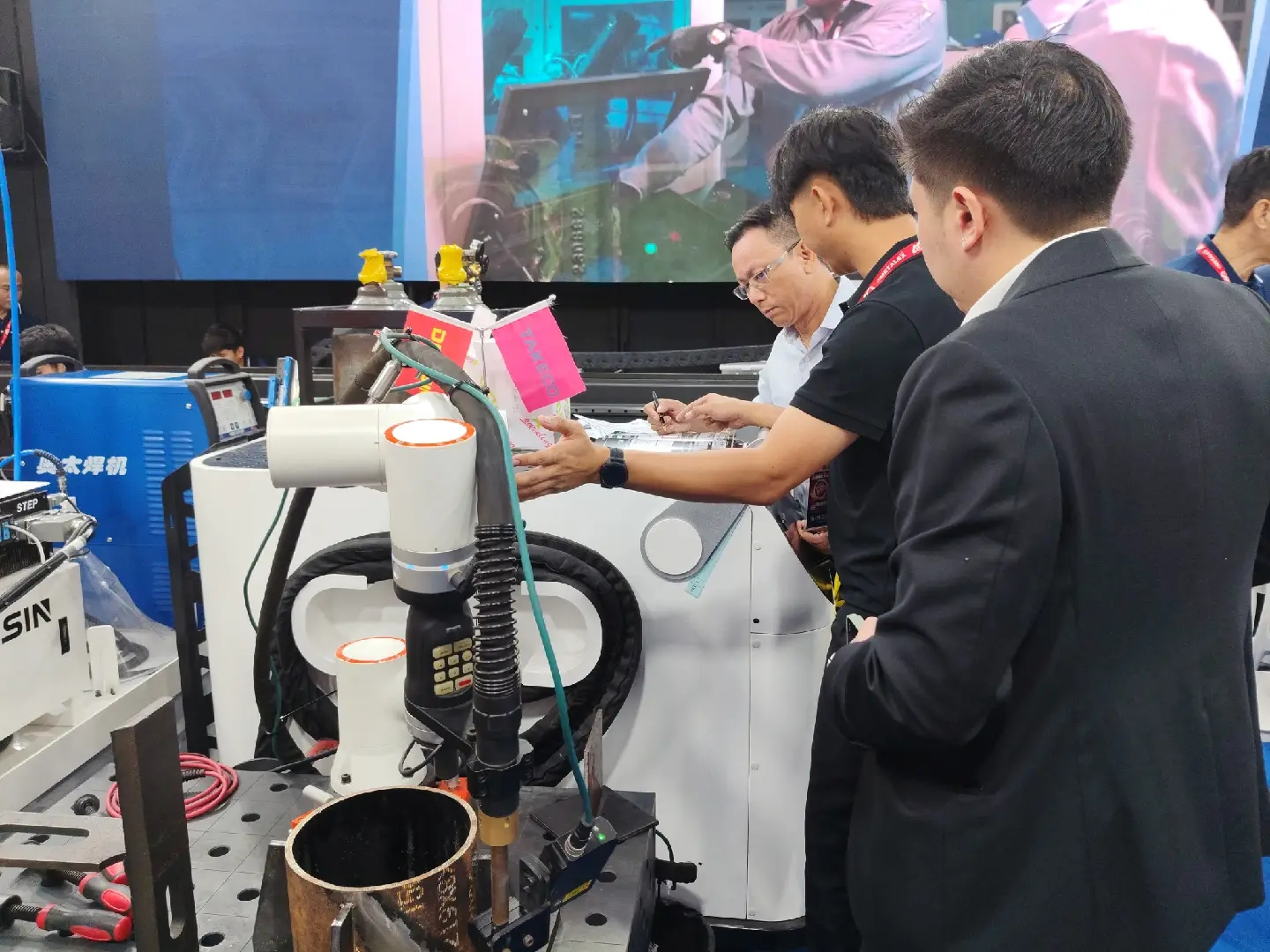
The demonstration shows how the system fits into a familiar shop setup. A perforated welding table accepts standard clamps and fixtures, so the same table can be configured for different workpieces. The arm’s slim profile helps the torch reach around pipes or into corners, while the integrated cable routing keeps the welding lines organized as the arm moves. The production cell still needs appropriate safeguards for robot motion, arc exposure, and welding fumes.
Where an RW welding cobot fits
A good first job is one with repeatable welds, reliable part fit-up, and enough recurring volume to justify the setup. That could be pipe brackets in a job shop, appliance frames and cabinets on a mixed production line, or supports and small assemblies in a structural steel or marine workshop.
Once a job is set up, the robot can maintain a consistent torch angle, travel speed, and wire stick-out from part to part. That repeatability helps control variation. Weld quality still depends on joint preparation, fit-up, and process settings. Skilled welders can use their time to set up jobs, inspect finished welds, and handle joints that are difficult to automate.
Choosing the right reach and workholding
One option in the range is the RWS-Smart-5, an air-cooled, modular system with a stated arm reach of 922 mm and a maximum weld size of up to 1,800 mm, depending on the setup. Arm reach and weld size describe different limits. To size a cell, check whether the torch can reach every joint at the required angle with the part and clamps in place. A positioner can help when the part needs to be rotated for better access.
Start with a representative part and share its dimensions, joint drawings, material, thickness, welding process, and typical batch size. DONSIN’s online selector can suggest a starting configuration. A trial weld on your own part gives you a better basis for judging setup time, weld quality, and production payback.
Explore the DONSIN RW Series · Request a quote or welding demonstration


