
Large cylindrical tanks and vessel components are difficult to weld consistently by hand: the workpiece is heavy, the joint is continuous, and torch angle must remain stable throughout the rotation. A coordinated system built around the DONSIN RW collaborative welding robot provides a practical route to repeatable circumferential welding without committing the workshop to a large fixed production line.
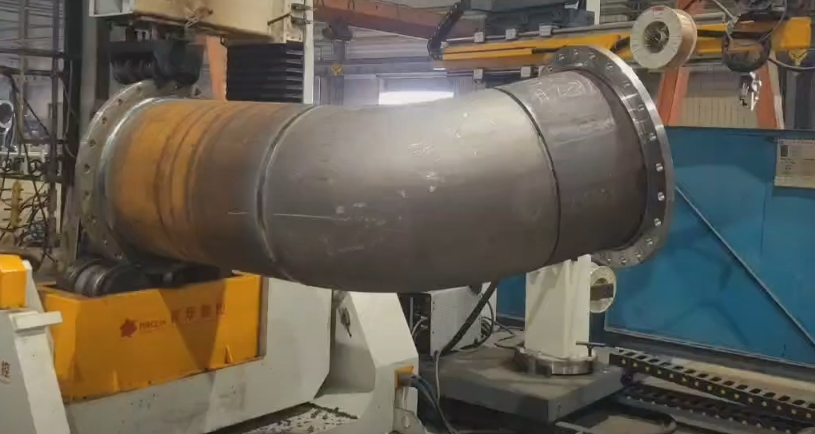
Why Ship Tank Welding Is a Good Automation Target
Many shipboard tanks, pressure-bearing fabrications and large pipe assemblies contain circular or near-circular joints. The path itself is predictable, but the length of the seam makes manual consistency difficult. A welder must maintain travel speed, work angle and contact-tip distance while working around a large component. Fatigue and repositioning can produce interruptions or variation along the joint.
Robotic welding changes the task from manually following the circumference to controlling the relationship between the torch and a rotating workpiece. The rotary positioner carries the component through the weld zone, while the RW cobot maintains the programmed torch orientation. This division of work is especially useful when the part is too large or awkward to manipulate by hand.
How the RW Cobot and Positioner Work Together
The robot and positioner should be treated as one coordinated process. The fixture locates the component, the positioner controls rotation, the robot holds the torch at the required angle and stand-off, and the welding power source delivers the qualified process parameters.
| System element | Function in tank welding | Engineering focus |
|---|---|---|
| RW collaborative robot | Positions the torch and follows the programmed joint | Reach, posture, cable routing and collision clearance |
| Rotary positioner | Rotates the cylindrical workpiece through the weld zone | Load capacity, center of gravity and speed stability |
| Fixture | Locates the shell and flange concentrically | Repeatable fit-up, runout and access for tack welds |
| Welding package | Controls arc, wire feed and weld parameters | Material, thickness, joint design and qualified procedure |
| Safety equipment | Controls arc, heat, fume and motion hazards | Risk assessment, screens, extraction and safe access |
Recommended Workflow for a Cylindrical Vessel Component
- Review the drawing and welding procedure. Confirm material, thickness, groove geometry, weld position, process and acceptance requirements.
- Design the fixture around the center of rotation. The component must remain stable and concentric. Excessive runout becomes torch-to-joint variation during rotation.
- Set and verify the joint. Control root gap, alignment and tack placement before teaching the robot.
- Teach the torch pose. Establish work angle, travel angle and contact-tip distance at representative points around the joint.
- Synchronize motion and process. Match positioner speed, robot motion and welding parameters to the approved procedure.
- Run a sample and inspect it. Verify start/stop overlap, bead profile, penetration and any project-specific NDT requirement before production.
Where the RW Collaborative Robot Adds Value
The RW series is suited to workshops that need flexible automation rather than a dedicated line for one component. Operators can teach a path at the workstation and reuse the program for repeat parts. When the next tank or pipe section changes, the cell can be re-fixtured and the weld path adjusted instead of rebuilding a large hard-automation system.
This makes the concept relevant to shipyard pipe shops, marine equipment manufacturers and fabricators producing multiple tank or vessel variants in modest batch sizes. The value comes from repeatable torch motion, reduced operator exposure to arc time and a more controlled process—not simply from robot speed.
What to Provide for a Feasibility Review
- Part drawing or 3D model, including overall dimensions and weight
- Material grade and thickness
- Joint type, groove preparation and weld length
- Required welding process and available power source
- Current production quantity and takt-time objective
- Applicable inspection or classification requirements
For system details, see the DONSIN RW collaborative welding robot and our guide to welding robots in shipbuilding.
Evaluate Your Tank Welding Application
Send DONSIN your workpiece drawing, material and weld requirements. Our engineering team will review the robot reach, fixture and positioner concept.
Request a Welding Solution


