
Most buyers start a welding cobot search by comparing robot arms. That is understandable, but it can lead to the wrong machine. A welding cobot is a complete working system, so the practical question is not simply which arm looks best—it is which reach, welding envelope and configuration fit the parts you weld every day.
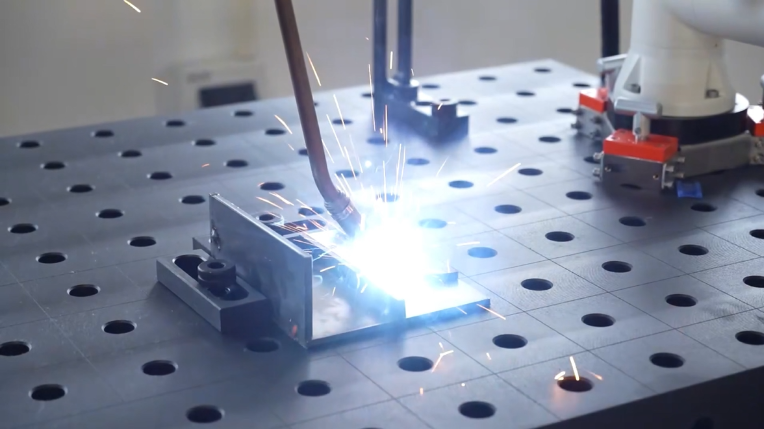
What Is Included in a DONSIN RW Welding Cobot?
An RW unit is a complete cobot welding system. The robotic welding arm sits on a mobile main unit that also carries the welding source and control system. The main unit measures 1,600 × 730 × 1,200 mm and is designed for plug-and-play deployment without a fixed installation.
The standard package includes:
- A lightweight collaborative robot arm
- A Megmeet EVO 500HPR pulse welding power source rated at 500 A, with a matching water-cooling tank
- A wire feeder positioned about 3 m from the welding gun as standard, with customization available
- Graphical drag-and-drop programming for shorter operator training
- A process database containing more than ten welding-parameter libraries
All four models support CO₂, MAG and MIG welding on carbon steel and stainless steel with solid or flux-cored wire. Power input is three-phase 380 V. The main unit, welding source, cooling method and supported materials remain consistent; in practical terms, you are mainly choosing the arm.
RW-3 vs RW-5 vs RW-10 vs RW-20
| Model | Working radius | Effective welding size | Repeat positioning | Typical TCP speed | Robot-arm weight |
|---|---|---|---|---|---|
| RW-3 | 622 mm | ≤1,100 mm | ±0.02 mm | 1 m/s | 35 kg |
| RW-5 | 922 mm | ≤1,800 mm | ±0.02 mm | 1 m/s | 55 kg |
| RW-10 | 1,400 mm | ≤2,600 mm | ±0.05 mm | 1.5 m/s | 61 kg |
| RW-20 | 1,900 mm | ≤3,700 mm | ±0.1 mm | 2 m/s | 61 kg |
Technical values are the current website reference specifications. Final configuration should follow the sales technical solution and a representative welding trial.
Start with Effective Welding Size
“Effective welding size” describes the largest workpiece dimension the system can cover. Measure the biggest part you weld regularly and add a practical margin for fixtures, torch posture and approach clearance. If a typical part is 900 mm but a regular order reaches 1,600 mm, an RW-3 will require frequent repositioning, while an RW-5 or larger gives the arm enough coverage.
Do not oversize automatically. A larger arm is heavier and normally costs more. If 95% of your parts fit an RW-5, consider whether occasional larger work can be turned or welded in two setups before selecting an RW-10 or RW-20.
How Accuracy and Speed Change with Arm Size
As the arm grows, repeat positioning accuracy changes from ±0.02 mm on RW-3 and RW-5 to ±0.05 mm on RW-10 and ±0.1 mm on RW-20. Typical endpoint speed rises from 1 m/s to 2 m/s.
This does not mean the larger arm produces poor welds. For many fillet and butt welds on fabricated steel, variation in part fit-up is greater than the robot’s repeatability, so reach is usually the more important selection factor. Tight-tolerance small parts and thin-walled components are where the ±0.02 mm models provide the clearest advantage. Always confirm the result with your actual parts.
Match the Welding Process to the Material
All RW models are arc-welding cobots for carbon steel and stainless steel with a 500 A welding source. They suit steel structures, shipbuilding components, energy equipment, furniture frames, fitness equipment and agricultural machinery.
If your work involves thin sheet, minimal heat distortion or fine cosmetic seams, compare the DONSIN LW laser welding cobot instead of assuming that a larger arc-welding arm is the answer.
Programming and Production Functions
DONSIN lists the following RW-series functions:
- Graphical programming and drag-and-drop teaching
- Arc tracking and oscillating, or weaving, welding
- Automatic identification of flat and vertical welding
- Step welding and multi-layer, multi-pass welding
- Welding-interruption recovery so a stopped weld can resume
These functions matter in production. Weaving helps bridge controlled gaps, multi-pass capability supports thicker joints, and interruption recovery reduces the risk of losing a part when wire runs out or a process is paused.
Floor Space, Fixtures and Safety
RW units are mobile and can be moved between workstations. You still need a three-phase 380 V supply, floor space for a main unit weighing about 395 kg excluding the arm, and a suitable fixture or table.
The collaborative arm can stop or slow on contact, but welding hazards remain: arc radiation, spatter, hot parts and fumes. Complete a site-specific risk assessment, follow local regulations, and include welding screens and fume extraction in the station design.
Which RW Model Fits Which Work?
Small parts, brackets, thin-walled components and precision-focused work.
General fabrication, frames, cabinets and mixed everyday production.
Larger frames, structural parts and panels requiring more coverage.
Large workpieces and applications where wide reach is the priority.
For long repetitive steel members and larger structural assemblies, consider the RA industrial platform described in our guide to teachless robotic welding for H-beams and steel structures.
Six Questions to Ask Before Buying
- What is the largest part I weld regularly, and how will I fixture it?
- Which materials, thicknesses and wire types do I use?
- Do I need arc welding only, or should I also evaluate laser welding?
- Who will program and operate the system, and how long is the training?
- What does the warranty cover, and how is technical support provided?
- Can I test my own parts before finalizing the model?
For related deployment and safety questions, see the DONSIN robotic welding FAQ.
Choose the Right RW Welding Cobot
Send DONSIN your drawings, material, thickness and monthly volume. Our engineers will recommend an RW model and arrange a representative test weld.
Request a Welding Cobot Recommendation


