
"How much does a welding cobot cost?" is the most common question buyers ask, and also the hardest to answer in one number. Two quotes can differ widely because they include different things. One may be only a robot arm. Another may be a complete, ready-to-weld system.
This guide shows what belongs in the cost, which costs are easy to forget, and how to estimate payback using your own figures. We do not quote prices here, because the right number depends on your configuration. The aim is to help you compare quotes fairly.
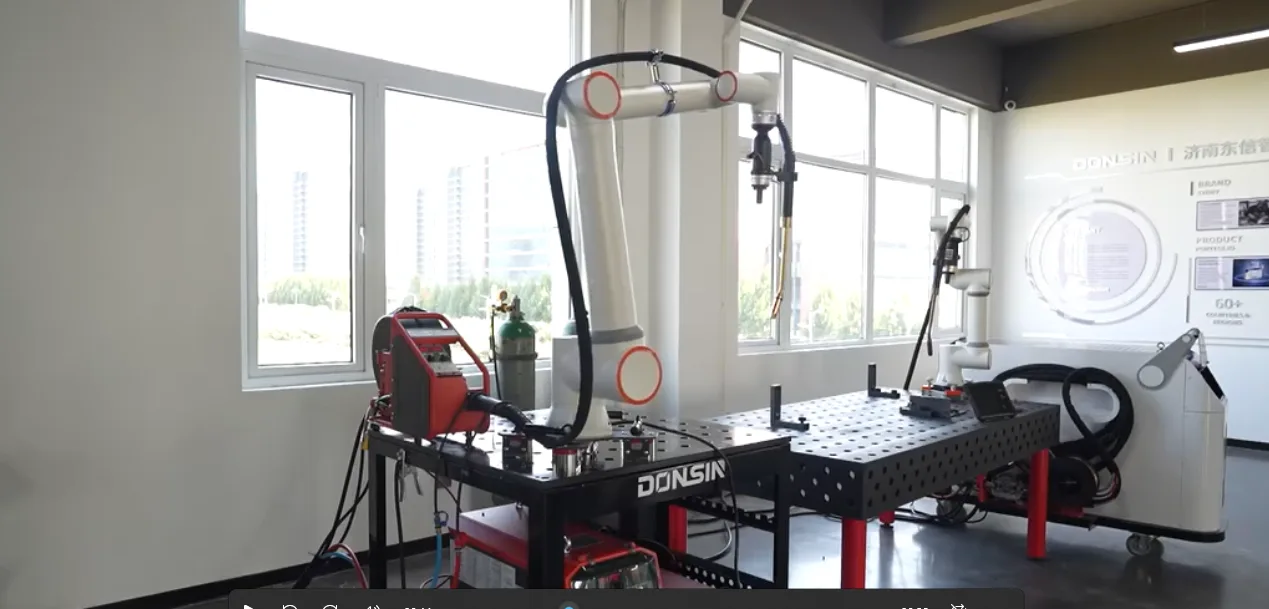
Step 1: Find out exactly what the price includes
A welding robot arm moves the torch. It does not weld on its own. A welding cobot system adds the parts that make a weld possible. When you compare offers, check each of these:
- Robot arm and controller
- Welding power source (current rating, pulse capability)
- Wire feeder and torch
- Cooling system for the torch, if water-cooled
- Programming software and process parameters
- Moving base or workstation
- Fixture table or positioner
- Safety items such as welding screens
- Training, installation and warranty
Step 2: Add the costs that are not on the quote
Many projects go over budget because of items outside the supplier's price list.
| Cost | Why it matters |
|---|---|
| Fixtures and tooling | Repeatable part positioning is what produces repeatable welds |
| Fume extraction and screens | Required for a safe welding station, with or without a robot |
| Electrical supply | The RW series needs three-phase 380 V; check your site |
| Consumables | Wire, shielding gas, contact tips and nozzles |
| Training time | Operators spend hours away from production while they learn |
| Maintenance and spares | Torch parts, cables, cooling system service |
| Weld preparation | Better fit-up and cleaning may be needed to get consistent results |
| Quality documentation | Test coupons, procedure qualification and inspection |
None of these is a reason not to automate. They are reasons to include a margin in the budget.
Step 3: List the benefits you can actually measure
Be conservative. Only count what you can tie to a number from your own shop.
- Labor. Count welder hours that move to the cobot, including overtime and the cost of unfilled positions. Where skilled welders are hard to hire, the real benefit may be production you could not otherwise do.
- Rework and scrap. If you grind, repair or re-weld a share of parts today, any reduction goes straight to savings.
- Throughput. More welds per shift can mean more orders delivered, but only if the rest of your process can keep up.
- Consistency. Repeatable weld quality reduces inspection failures and customer returns.
- Welder time reassigned. Welders freed from repetitive work can do fitting, finishing or programming.
Step 4: Use a simple payback formula
The payback calculation
An illustration with made-up figures (not a DONSIN quotation):
| Item | Amount |
|---|---|
| Total investment, including fixtures, training and installation | $100,000 |
| Annual labor and rework savings | $70,000 |
| Annual running cost | $10,000 |
| Net annual benefit | $60,000 |
| Payback | 100,000 ÷ (60,000 ÷ 12) = 20 months |
Run the formula twice: once with your best estimate, and once with benefits reduced by 30%. If the conservative case still works, the decision is safer.
Step 5: Check utilization, because it drives everything
A cobot that welds for two hours a day pays back far more slowly than one that welds for six. Before you buy, ask:
- How many hours per week of repetitive welding can this system realistically take over?
- Can it move between jobs? (A mobile base, as in the RW series, helps here.)
- Do you have enough similar parts to keep it busy?
- Does one operator also load parts while it welds?
Many published industry guides quote payback periods of roughly one to two years. Use them as rough benchmarks only, because they come from different applications, countries and labor costs.
When the cobot is the wrong answer
Sometimes the better investment is different equipment:
- Long, heavy, repetitive steel members: a track-mounted industrial system, such as the DONSIN RA series, may fit better.
- Thin sheet needing low heat input and a clean appearance: a laser welding system may suit the job better than arc welding.
- Very small batches of one-off parts: manual welding may remain more economical.
A checklist for comparing quotes
- Is the welding power source included, and what is its current rating?
- Is the cooling system, wire feeder and torch included?
- Does the price include training, installation and a warranty?
- What fixtures or tables are needed, and who supplies them?
- What are the electrical and space requirements?
- Can you test your own parts before buying?
- What support is available after delivery?
The takeaway
The cheapest quote is not always the cheapest system. Compare what each price includes, add the costs outside the quote, count only the benefits you can measure, and test the payback with a conservative case.
Want a payback estimate for your parts?
Send us your drawings, monthly volume and current welding hours. We will recommend a configuration and help you build the calculation.
Get a quote →FAQ
How much does a welding cobot cost?
It depends on the arm size, welding power source, included accessories, fixtures and service. Compare complete systems with the same scope, not just robot arms.
How long does it take for a welding cobot to pay back?
It depends on utilization, labor cost and rework levels. Calculate it with your own numbers using a conservative scenario.
Is a welding cobot cheaper than an industrial welding robot?
Often the initial setup is simpler, but the right choice depends on part size, weight and volume. Large, repetitive steel parts may suit an industrial track system better.


